
Comparison
AguaForce Water-Filled Weights vs. Foam Aqua Dumbbells: Which Is Better for Aqua Fitness Classes?
Last updated
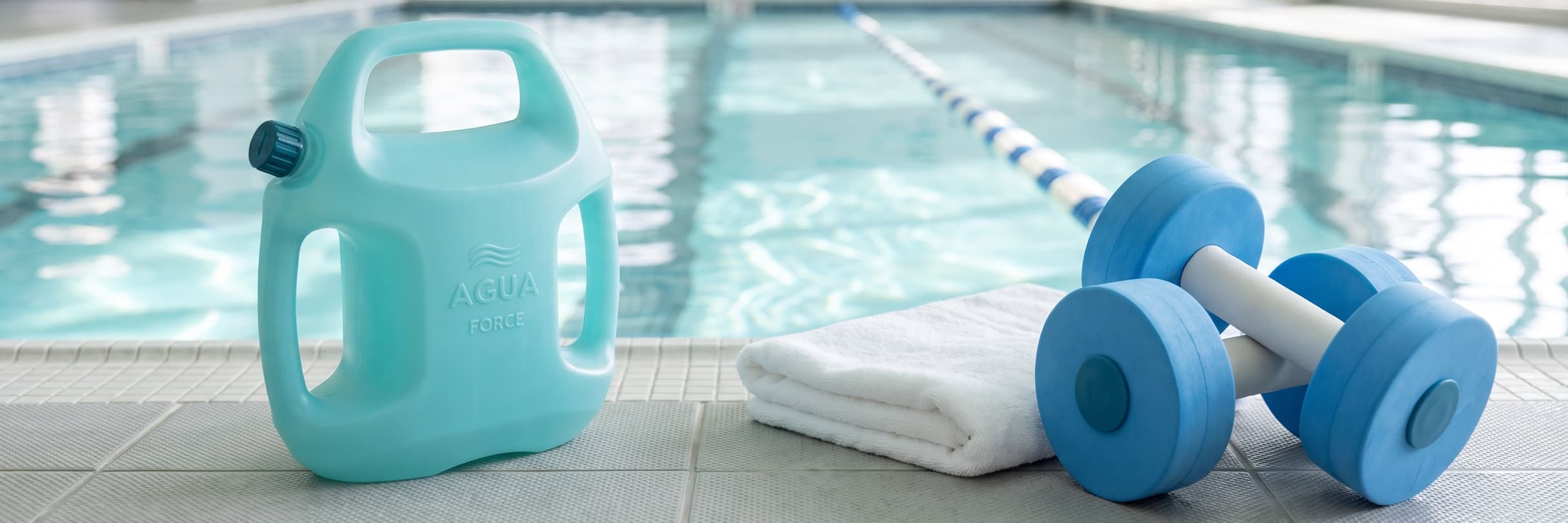
For aquatic instructors who teach strength in the water, AguaForce water-filled weights are the more versatile choice: empty, they resist under the water like foam aqua dumbbells, with buoyancy you can lower a cup of water at a time for each participant, and filled, they weigh up to 11 lb for moves above the surface and on land. Foam aqua dumbbells are the better pick if you want the simplest, cheapest equipment for every participant: the two best sellers we checked cost $21.99 a pair, weigh 4.5 oz each and need no setup, but they only resist under the water, at one level per size.
At a glance: quick comparison
| AguaForce water-filled weights | Foam aqua dumbbells | Takeaway | |
|---|---|---|---|
| Best for | Strength work in and out of the water, and mixed-ability classes | Simple, low-cost equipment for moves under the water | — |
| How it resists | Buoyancy and drag when empty; its weight when filled | Buoyancy and drag | AguaForce |
| Buoyancy, held under | Roughly 10 lb empty, less with every cup of water | Fixed by the foam's size | AguaForce |
| Weight above the water | 1–11 lb, set with water | 4.5 oz | AguaForce |
| Changing resistance | Add or pour out water | Buy another size | AguaForce |
| Setup | Fill before class; empty and dry after | None | Foam aqua dumbbells |
| Grip | Three handles: one on top, two on the sides | One padded bar | AguaForce |
| If dropped | Rounded plastic, up to 11 lb filled | 4.5 oz of foam that floats | Foam aqua dumbbells |
| Size and weight, each | 12.3 × 4.7 × 13.7 in, 0.8 lb empty | 10.6–10.8 × 6 in, 4.5 oz | Foam aqua dumbbells |
| On land | Yes, filled up to 11 lb | No | AguaForce |
| Price | $39 for a set of 2 | $21.99 a pair on Amazon | Foam aqua dumbbells |
| Main drawback | Costs more, takes more space, and needs filling and emptying | Pool only, with one resistance per size | — |
| Our pick | Strength, mixed-ability and therapy classes, and instructors who also teach on land | Cardio and deep-water classes on a tight budget | AguaForce for most strength classes |
How we compared them
Foam aqua dumbbells are also sold as water dumbbells, aquatic exercise dumbbells, hand buoys and pool weights: two foam ends on a short bar, light on land and buoyant in the water. AguaForce makes the other option, so we kept to facts you can check: AguaForce's specifications, the Amazon listings of two of the best-selling foam aqua dumbbell pairs, what verified buyers of each report, and guidance for instructors from WaterART Fitness International. On October 2, 2026, they were the No. 4 and No. 8 best sellers in Amazon's Aquatic Exercise Equipment category, and they're nearly identical, so we treat them as typical of foam aqua dumbbells. Where foam dumbbells come out ahead, we say so.
| Size | Weight, each | Grip | Sizes offered | Price, pair | Amazon rating | |
|---|---|---|---|---|---|---|
| No. 4 best seller | 10.8 × 6 in | 4.5 oz | Non-slip foam bar | One size | $21.99 | 4.7 out of 5 (4,553 ratings) |
| No. 8 best seller | 10.6 × 6 in | 4.5 oz | Foam-padded bar with two grip strips | Large or X-Large | $21.99 with Prime, $27.99 without | 4.7 out of 5 (5,894 ratings) |
- Resistance in the water: how each one works against buoyancy and drag.
- Progression: how small a step up each one allows.
- Mixed-ability classes: serving first-timers and regulars with the same equipment.
- Above the water and on land: resistance once the weight leaves the water.
- Class flow: setup before class and switching during it.
- Grip and control: for small, weak and arthritic hands.
- Safety: for feet, pool floors and shoulders.
- Durability: in chlorinated water, class after class.
- Storage and transport: space on deck, and carrying a class set.
- Cost: for one participant and for a class.
How does each one resist in the water?
The same way, under the water. Both float, so pushing them down works against buoyancy, and moving them through the water works against drag. A foam aqua dumbbell's buoyancy is fixed by how much foam it has. An empty AguaForce weight held fully under pushes up with roughly 10 lb, by our estimate from the water it holds, and each cup of water you add takes about 0.52 lb off that.
- AguaForce: Buoyancy you set with water: held under, it pushes up with roughly 11 lb minus its fill line, so about 6 lb at the 5 lb line. Its flat sides, 12.3 × 13.7 in, push a lot of water when led flat-first; turn it edge-first, 4.7 in wide, to slice through with less drag.
- Foam aqua dumbbells: Buoyancy set by its two 6 in foam ends, which neither listing puts a number on. Participants make it harder by moving faster.
| Filled to | Weight above the water | Push up when held under |
|---|---|---|
| Empty | 0.8 lb | About 10 lb |
| 3 lb line | 3 lb | About 8 lb |
| 5 lb line | 5 lb | About 6 lb |
| 7 lb line | 7 lb | About 4 lb |
| 9 lb line | 9 lb | About 2 lb |
| 11 lb line | 11 lb | Close to none |
Instructors use it empty for underwater moves such as the frog crunch and side bend, and filled for moves that break the surface, such as the lateral raise. See each one in the exercise library.
Winner: AguaForce, for range. You set its buoyancy with water and its drag by turning it, while a foam dumbbell gives one level.
Which lets participants progress in smaller steps?
AguaForce. In the water, you change its buoyancy a cup at a time: start a new participant with the weight mostly full, so it barely floats, and pour water out as they get stronger. Above the water it works the other way: add water, half a cup (about 0.26 lb) at a time, up to 11 lb. A foam dumbbell has one level of buoyancy, so moving up means buying a bigger size: one of the pairs we checked comes in Large and X-Large, the other in one size.
- AguaForce: Fill lines in lb and kg, molded into the translucent body, so a participant can repeat last week's level or go one line further. Each weight in the set can be filled to a different level.
- Foam aqua dumbbells: One buoyancy per pair. WaterART Fitness International, which trains and certifies aqua fitness instructors, calls foam dumbbells advanced equipment, and advises starting new or less strong participants on smaller, less buoyant bells, or with no equipment.
Winner: AguaForce. Small steps let participants progress while still controlling the weight on its way up.
Which works better for a mixed-ability class?
AguaForce. Each participant fills their pair to a level they can control, so one kind of weight serves a first-timer and a strong regular in the same class. With foam dumbbells, everyone holds the same buoyancy unless your pool stocks several sizes, and a participant who can't keep their shoulders under the water has to switch to a smaller bell or work without one.
- AguaForce: Hand out identical weights and let each participant fill to their own line before class, then adjust between classes as they progress.
- Foam aqua dumbbells: Every pair gives the same buoyancy. Offering easier and harder options means buying several sizes and keeping them sorted on deck.
Winner: AguaForce. One kind of weight scales to everyone in the class.
Which works for moves above the water and on land?
AguaForce. A foam aqua dumbbell weighs 4.5 oz, so it gives no resistance once it leaves the water, and WaterART advises against lifting buoyant equipment in and out of the water with the arms out to the side, which can impinge the shoulders. Fill AguaForce instead and it's a real weight, up to 11 lb, for lateral raises, curls and presses at or above the surface, deck circuits and land classes.
- AguaForce: Filled, it keeps its weight as it breaks the surface; a pool instructor who reviewed it found that filled weights keep resistance in lifts like the lateral raise. Participants can use the same weights for workouts at home.
- Foam aqua dumbbells: 4.5 oz each, so above the water it's like holding nothing. Pool only.
Winner: AguaForce. Foam dumbbells only work under the water.
Which is quicker to set up and use in class?
Foam aqua dumbbells. There's nothing to prepare: hand them out, and they dry quickly after class. AguaForce has to be filled before class for any moves that use it filled, then emptied and left to air-dry, and switching a weight between empty and filled mid-class takes time. Grouping the filled and empty exercises into separate blocks keeps that to one switch.
- AguaForce: Fill to the line before class, from a tap or hose near the pool, and close the cap firmly so pool water can't seep in and change the resistance. Empty it and let it air-dry after class.
- Foam aqua dumbbells: Nothing to fill, empty or check. Hand them out and collect them.
Winner: Foam aqua dumbbells. Grab and go beats filling and emptying.
Which is easier to grip and control in the water?
AguaForce, for most participants. It has three handles: one on top, and two on the sides that participants can hold with both hands for steady control as the water pushes back. A foam aqua dumbbell has one bar between its two ends, padded with foam, which is soft on the palm but gives one way to hold it. A pool instructor who reviewed AguaForce found its handles easy for younger and older participants to grasp, including those with arthritic hands.
- AguaForce: Smooth, hard plastic handles about 1 in (2.5 cm) across. Holding both side handles spreads the load across two hands, and turning the weight upright or on its side changes the move without changing the grip.
- Foam aqua dumbbells: One padded bar per dumbbell, held in one hand. Reviewers find them comfortable, though one says the bar could be longer, and one with rheumatoid arthritis in their hands found them heavier than expected.
Winner: AguaForce. Two-handed grips give more control, which matters most for weak or arthritic hands.
Which is safer in and around the pool?
Foam aqua dumbbells, narrowly. At 4.5 oz of foam, there's nothing on them to hurt a foot or chip a tile, on deck or in the water. AguaForce is rounded plastic with no metal and won't damage a pool floor if dropped, but filled, it can weigh up to 11 lb on deck. In the water, the bigger risk with either is too much buoyancy: if a participant can't control the weight on its way up, their shoulders come out of the water, which WaterART links to shoulder impingement. You can lower AguaForce's buoyancy with water; with foam, you need a smaller bell.
- AguaForce: Nothing to rust, crack or come apart, and safe on tile, plaster and fiberglass. Carry it to the pool empty or lightly filled, and set it down rather than dropping it.
- Foam aqua dumbbells: Floats if dropped and weighs next to nothing on deck. Big bells are the hardest to control on the way up, so match the size to the participant.
Winner: Foam aqua dumbbells. Nothing is gentler to drop, though AguaForce makes it easier to match buoyancy to each participant.
Which holds up better to chlorine and daily classes?
AguaForce, on materials. Its body is thick high-density polyethylene (HDPE), which isn't affected by chlorine or salt water, holds its shape under water pressure, and doesn't soak up water. The foam dumbbells we checked are EVA foam, which resists chlorine and dries quickly, and most buyers rate them highly for quality, but some report the foam shedding after a summer, or water getting inside the handles.
- AguaForce: Empty it after class, and don't leave it filled anywhere below freezing. A 30-day money-back guarantee covers breakage.
- Foam aqua dumbbells: Soft foam wears with handling. A few buyers say it began shedding after a season, or that water got inside the handles and was hard to get out.
Winner: AguaForce. Hard plastic won't shed or take on water the way worn foam can.
Which is easier to store and carry to the pool?
Foam aqua dumbbells. Each weighs 4.5 oz and measures about 10.6–10.8 × 6 in, so a class set fits in a mesh bag. An empty AguaForce weight weighs 0.8 lb and measures 12.3 × 4.7 × 13.7 in, about 2 times the space of a foam dumbbell, though its flat sides stack neatly in a bin.
- AguaForce: A set of 2 weighs 1.6 lb empty. Instructors who teach at more than one pool, or also on land, carry one kind of equipment instead of two.
- Foam aqua dumbbells: Light and compact, though their round ends roll, so they're best kept in a bag or bin.
Winner: Foam aqua dumbbells. Smaller and lighter, with nothing to empty first.
Which costs less to equip a class?
Foam aqua dumbbells. Both pairs we checked cost $21.99 on Amazon on October 2, 2026, against $39 for an AguaForce set of 2. For a class of 20, that's $439.80 for foam dumbbells and $780.00 for AguaForce. AguaForce also does the job of light hand weights for work above the water and on land, so the gap narrows if you'd buy both. Pools can buy any quantity through the wholesale program, and request a free demo set first.
- AguaForce: $39 for 2 weights that each work empty in the water or filled from 1 to 11 lb, with free shipping to the US and Canada and free returns within 30 days.
- Foam aqua dumbbells: $21.99 a pair for both pairs we checked, one of them for Prime members only ($27.99 otherwise). A bigger size, for more buoyancy, is another pair to buy.
| What you get | Price | Class of 20 | |
|---|---|---|---|
| AguaForce | Set of 2, each empty or 1–11 lb | $39 | $780.00 |
| No. 4 best seller | Pair of foam dumbbells | $21.99 | $439.80 |
| No. 8 best seller | Pair of foam dumbbells | $21.99 | $439.80 |
Winner: Foam aqua dumbbells. They cost $17.01 less per participant.
Pros and cons
Each option in short, with the limitations worth knowing before you buy for your pool.
AguaForce water-filled weights
Bottom line: One weight for strength work under the water, empty, and above it, filled up to 11 lb, that each participant sets to their own level.
Pros
- Works empty under the water and filled, up to 11 lb, above it and on land
- Buoyancy you lower a cup of water at a time, so each participant works at a level they can control
- Three handles, including two side handles for a steady two-handed grip
- Hard HDPE plastic that chlorine and salt water don't affect
- One kind of weight for pool classes, land classes and home workouts
Cons
- $39 a set, $17.01 more than a foam pair
- Needs filling before class, and emptying and drying after
- About 2 times the space of a foam dumbbell, and up to 11 lb on deck when filled
- Empty, its roughly 10 lb of buoyancy is too much for many beginners, so start them with water in it
Foam aqua dumbbells
Bottom line: Light, low-cost equipment for moves under the water, ready to hand out with nothing to prepare.
Pros
- $21.99 a pair, the lowest cost per participant
- Nothing to fill, empty or dry out
- Floats if dropped, and gentle on feet and tiles
- Familiar to most participants, and easy to hold in deep water
- Compact and light to carry and store, at 4.5 oz each
Cons
- Resist only under the water, so they're no use above it or on land
- One buoyancy per size, so offering easier and harder options means stocking several sizes
- One padded bar each, so one way to hold them
- Some buyers report foam shedding after a season, or water getting inside the handles
Which is better for shallow-water aqua aerobics?
AguaForce, if your classes include a strength block. Use it empty for underwater pushes and presses, and filled for moves at and above the surface, so one set covers the whole block. If your classes are mostly cardio with a few arm moves under the water, foam aqua dumbbells are simpler: nothing to fill, and $21.99 a pair.
Kellie Powell, Director of Aquatics at YMCA Rome-Floyd County: “Our Aqua Aerobic classes are loving the Aqua Water Weights! We are using them with water and without - which is super hard and fun!”
Which is better for deep-water classes?
Foam aqua dumbbells are the familiar choice: they're light to hold through a whole class, and most participants already know them. AguaForce works in deep water too, empty or part-filled, for strength segments where its side handles give more control. With either, participants should wear a flotation belt, since neither is a flotation device.
Which is better for arthritis, rehab and older-adult classes?
AguaForce suits most of these participants better. You can start them with the weight mostly full, so it barely floats, and lower the water in small steps as they get stronger, instead of handing everyone the same buoyancy. Its side handles let weak or arthritic hands share the load. Foam dumbbells can be too much at first: a buyer of one pair we checked returned them for a smaller size, saying they weren't for beginners or rehab. Fill and close the caps for participants who struggle with jar lids, and ask anyone with a shoulder or neck condition to check with their doctor or physical therapist first.
The CDC notes that people can exercise longer in water without more joint or muscle pain, and that water-based exercise helps people with arthritis use their joints with less pain. See AguaForce for seniors for exercises they can also do at home.
Which is better if you also teach on land, or want participants to train at home?
AguaForce. The same weights work in your pool classes and, filled, in land classes and at home, so participants can keep training between classes. Foam aqua dumbbells only work in the water.
Every set comes with exercise cards, and the free AguaForce exercise library shows how to do each move. For land classes, see AguaForce for group fitness.
Should your pool buy AguaForce water-filled weights or foam aqua dumbbells?
Buy AguaForce if you teach strength in the water: one $39 set of 2 works empty under the water, with buoyancy you set with water, and filled up to 11 lb above the surface and on land, and it scales to every participant in a mixed-ability class. Buy foam aqua dumbbells if you want the simplest, cheapest equipment for every participant, mostly for moves under the water: $21.99 a pair, with nothing to fill. They also work well together: foam dumbbells for cardio and deep-water classes, and AguaForce for strength blocks and mixed-ability groups.
- Buy AguaForce if: your classes include strength work, you teach mixed-ability, arthritis or older-adult classes, you want moves above the water as well as under it, you also teach on land, or you want participants to train at home between classes.
- Buy foam aqua dumbbells if: you want the lowest cost per participant, your classes are mostly cardio or deep-water, or you want equipment with nothing to fill, empty or dry.
Buy the AguaForce 2-pack for $39 with free shipping to the US and Canada, or see AguaForce on Amazon to read more reviews and buy there. Pools can try it first with a free pool demo set, and buy any quantity at wholesale pricing. See AguaForce for pool classes for class ideas, and the guide to water-filled weights for how to fill, use and care for them.
Sources
- CDC, Swimming and Your Health
- WaterART Fitness International, Foam Weights or Water Dumbbells
- U.S. Geological Survey, Water Density
- Amazon listings, safety information and customer reviews of the No. 4 and No. 8 best-selling foam aqua dumbbells in Aquatic Exercise Equipment, checked on October 2, 2026
- AguaForce product specifications, in the 2-pack details
- AguaForce customer reviews, including a pool instructor's